| |
| |
|


 |
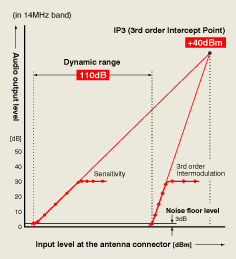
Dynamic range characteristics |
Icom's 40 years of analog RF circuit experience combined with cutting
edge digital technology results in an astonishing 110dB receiver dynamic
range and a +40dBm IP3 in the HF bands. A first in Ham radio! To achieve
this superior receiver performance, Icom's engineering team completely
reviewed the whole analog circuit and matched it to the DSP units.
This allowed us to explore new technical dimensions such as a double
conversion super-heterodyne system, mechanical relay BPF switching
and two roofing filters.

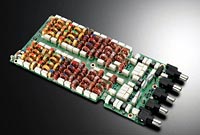
The IC-7800 uses highly reliable and durable mechanical relays for
BPF switching instead of non-linear semi-conductors which cause distortion.
The mechanical relay prevents 2nd order distortion at the primary
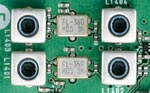
stage of signal processing. The IC-7800 has two roofing filters before
the 1st IF amplifier stage. One is 15kHz fileter for FM mode and the
other is 6kHz filter for SSB, CW, AM and data modes. The IC-7800 switches
between these two roofing filters depending on operating mode. Typically,
transceivers use only one broad 15kHz roofing filter for all modes.
This is not an optimal design for SSB, CW, or AM modes. The two roofing
filters dramatically improve the blocking characteristics from strong
adjacent signals.
BPF Unit |
|
Two roofing filters |

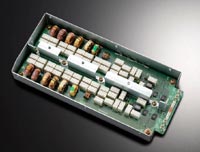
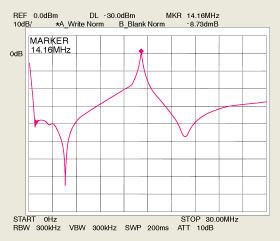
The pre-selector works from 1.5MHz to 30MHz. The preselector automatically
tracks the intended signal, keeping the pre-selector乫s bandwidth centered
on the operating frequency at several kHz steps (minimum). The preselector
rejects unwanted out of band interference from multi-multi operation
or strong broadcast stations, as your first line of defense against
interfering signals. The center frequency of the pre-selector is adjustable
from the DIGI-SEL tuning knob on the front panel.
Automatic preselector |
|
Automatic Preselector
Characteristics in 14MHz band |

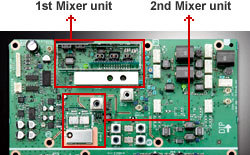
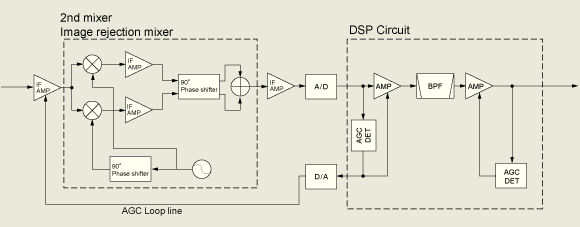
While mixers often become a cause of signal distortion and spurious
emissions, the IC-7800 utilizes a double conversion super-heterodyne
system using a newly developed image rejection mixer. A high performance
D-MOS FET array for the 1st mixer stage is infused with a signal from
the high-level C/N, high-drive Local Oscillator from the PLL unit.
This new mixer reduces signal distortion through IF processing and
provides a high-fidelity signal to the DSP unit.

The IC-7800 has two types of AGC loops. One of the AGC loops detects
the AGC voltage at the BPF input in the DSP unit and feeds back to
the 1st IF amplifier. This AGC loop prevents the saturation of the
1st IF amplifier from strong signals out of the BPF bandwidth, and
improves the dynamic range against adjacent signals. The other AGC
loop detects the AGC voltage at the digital IF filter output which
has only passed the intended signal and draws the full potential from
the digital IF filter. Combining the digital IF filter, manual notch,
and the 1st IF stage, these are all controlled by the DSP unit. 110dB
of ultra wide dynamic range in the receiver means the IF amplifier
is distortion free from strong signals.

|
AGC setting screen |
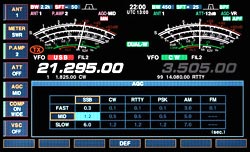
In addition to the preset AGC time constants (slow, medium and fast),
the manual AGC volume provides flexible detailed AGC tuning.

The ultimate dual receiver performance is at your control; the receivers
are completely independent all the way from the 4 antenna jacks, through
the pre-selectors, DSP, signal detectors, front panel control, and
right into the stereo headphone! The dual receiver allows you to receive
two different bands simultaneously in different modes, with each receiver
not causing any adverse affect to the other one. This true dual receiver
takes your band hopping and contesting experience to the next level!
|
| |
|
|
|